ORIGA, THE POWER OF GENERATIVE AI IN THE SERVICE OF CLINICAL TRIALS

ORIGA is Europe’s first web-based platform for augmenting clinical data with deep learning. It enables healthcare manufacturers and researchers to generate realistic artificial patients, while guaranteeing data confidentiality and regulatory compliance.

CLINICAL TRIALS PUT TO THE TEST OF REALITY

Clinical trials are essential to advance medical research, validate the effectiveness of a treatment, and improve patient care. But in practice, there are many challenges:
  • Slow and costly patient recruitment
  • Restricted access to high-quality data, sometimes incomplete or sensitive
  • Strict regulations (GDPR, AI Act) that limit the use and sharing of real-world data
  • Lack of representation of certain populations in cohorts
In light of these limitations, researchers and healthcare companies need innovative, reliable, and compliant tools to move further, faster — without ever compromising patient confidentiality.

OUR SOLUTION ORIGA

ORIGA is a web platform for clinical data augmentation designed to generate realistic synthetic patients, while ensuring a high level of security and compliance.

It is built around three key features:

Data augmentation with ORIGA involves enhancing your existing datasets by generating new, realistic synthetic data. This technique improves the robustness and performance of artificial intelligence models, particularly for training medical algorithms and conducting clinical trials where available real-world data may be limited.

ORIGA ensures the complete anonymization of your sensitive data by generating realistic synthetic data, while effectively protecting patient confidentiality. This way, you can share or use data without any risk of re-identification, making regulatory compliance easier.

Data imputation with ORIGA involves completing incomplete or missing datasets using synthetic data that is consistent with your original population. This method enhances the quality of your data and ensures the reliability of analyses, which is particularly critical in the context of clinical trials.

WHAT EXACTLY ARE VAEs?

ORIGA is based on advanced generative AI models called Variational Autoencoders (VAEs), developed in partnership with Professor Stéphanie Allassonnière, an expert in the field. VAEs make it possible to:
  • Learn the deep structure of clinical data (even complex or imbalanced)
  • Generate new patients who are statistically consistent but entirely fictional
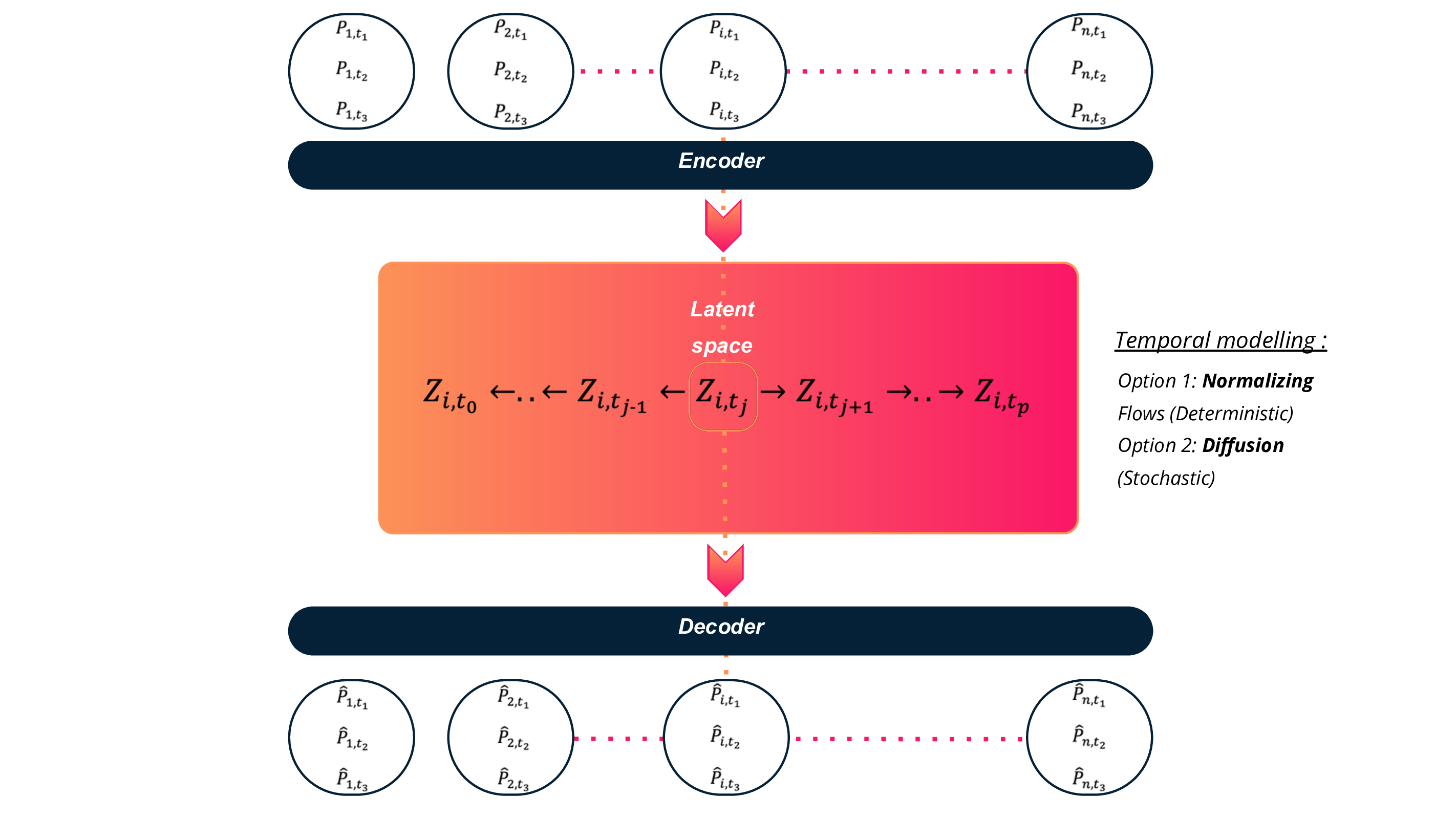
  • Model longitudinal data with a temporal approach, using extensions such as Normalizing Flows or Diffusion Models
In short: we don’t clone data — we create a credible and diverse artificial population.

REAL PATIENTS VS SYNTHETIC PATIENTS: WHAT’S THE DIFFERENCE?

The synthetic patients generated by ORIGA:

  • Do not correspond to any real individual
  • Faithfully reproduce the statistical properties of the original patients
  • Can be used without fear of data leakage or ethical bias
  • Allow the exploration of rare or underrepresented cases in real-world cohorts

Result: you preserve all the richness of clinical data while eliminating the risks associated with its use.

RELIABILITY, VALIDATION, AND HUMAN GUARANTEE COMMITTEE

To ensure the quality and relevance of the generated data, ORIGA includes:
  • Rigorous statistical validation (Wasserstein tests, Kullback-Leibler divergence, covariance, moments, etc.)
  • A human guarantee committee that evaluates the clinical plausibility of synthetic patients
  • A confidentiality test to ensure that no real data can be retrieved or inferred

SCIENTIFIC COMMITTEE

Photo du Pr. Stéphanie Allassonnière

PR. STÉPHANIE ALLASSONNIÈRE

Professor of Applied Mathematics and Vice President for Innovation and Industrial Partnerships at Université Paris-Cité, Chair and Deputy Director of PR[AI]RIE, Co-founder of Sonio

PR. VINCENT MINVILLE

Department Head, Intensive care anaesthetist, Toulouse University Hospital
Photo du Dr. Fabrice Ferré

PR. FABRICE FERRE

Intensive care anaesthetist, Toulouse University Hospital

Photo du Pr. Bertrand Marcheix

PR. BERTRAND MARCHEIX

Head of the Cardiac Surgery Department, Toulouse University Hospital

TOWARDS THE FUTURE OF CLINICAL RESEARCH

Logo France 2030

FRANCE 2030

BOTdesign is a winner of the France 2030 Export program since 2025, marking a key milestone in its international development. The program supports the export of innovative technologies like ORIGA, aimed at transforming the healthcare sector. With this support, BOTdesign will strengthen its presence abroad and develop new strategic collaborations.

I-NOV

BOTdesign is investing €1.4 million in ORIGA R&D, our platform dedicated to clinical research based on artificial patients. This project, supported by I-NOV funding under the France 2030 initiative, is being conducted with Prof. Allassonnière from Université Paris Cité. It aims to optimize RHVAE models to generate synthetic medical data while maintaining an ethical approach. This support positions BOTdesign as a future European leader in in silico clinical trials.

Variational Autoencoders (VAEs): An innovation for synthetic data

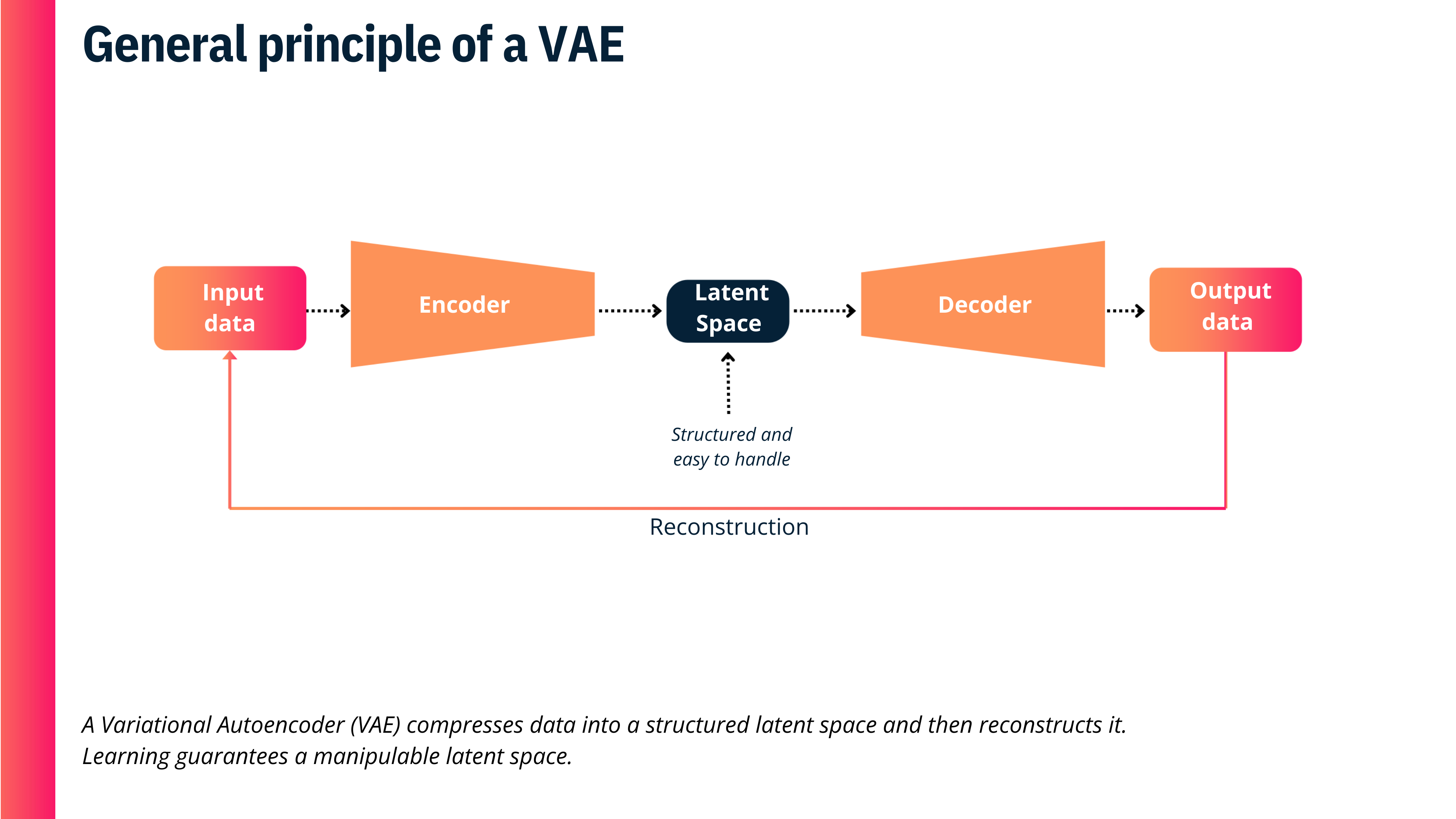
The Variational Autoencoders (VAEs) are deep generative models capable of creating realistic synthetic data from learned distributions. By projecting input data into a structured latent space and then resampling from this space, VAEs allow for the generation of new instances that are faithful to the statistical properties of real-world data.

At ORIGA, we’ve developed a range of VAEs tailored to the diversity of medical and industrial data: imaging, tabular data, time-series, image sequences, and multimodal data. Our expertise lies in fine-tuning the latent space and the generation mechanisms based on the type of data.
Our VAEs incorporate several key advancements:

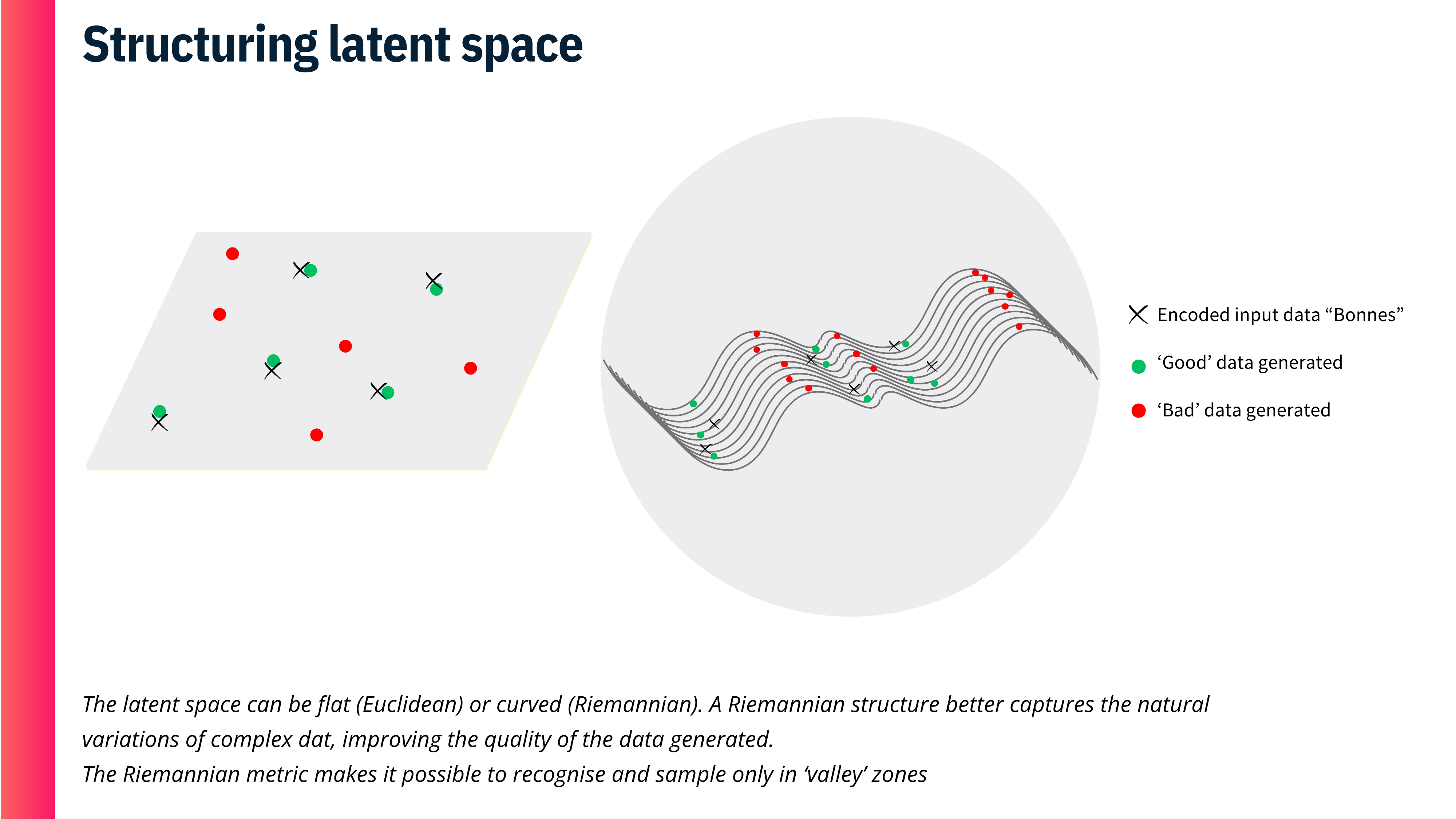
  • Riemannian latent spaces: To better capture the complexity of real-world data structures, we structure the latent space according to Riemannian manifolds, instead of a conventional Euclidean space. This allows for a more accurate modeling of nonlinear relationships and inherent constraints within the data.
  • Models for longitudinal data: For time-series or sequences (like the evolution of a patient over time), we use two complementary model families:
    • Normalizing Flows, a deterministic approach that transforms simple distributions into complex ones, while ensuring bijectivity. This provides fine control over the temporal dynamics of the data.
    • Diffusion Processes, a stochastic approach inspired by statistical physics, which models data generation as an inverse process of progressive noise. These models capture the uncertainty and natural variability present in real-world trajectories.

Option 1: Normalizing Flows – Deterministic evolution in the latent space

The model encodes each observation into a latent variable z_t.
To model the temporal evolution, we don’t impose dynamics on the images themselves, but directly on the latent representations.
With normalizing flows, a smooth and invertible transformation is applied to these latent variables to capture their evolution over time (zₜ₊₁ = fₜ(zₜ)).
Each z_t can then be decoded into an image x̂_t, ensuring temporal continuity and coherence in the generated sequence.

Option 2: Diffusion Process – Stochastic evolution in the latent space

Instead of deterministically transforming the latent representations, the model can learn to diffuse a latent variable over time by gradually adding controlled noise.
We simulate an inverse process where, starting from a noisy state, we learn to move back toward clearer and more structured states.
This mechanism captures a more realistic and stochastic dynamic in the generated sequences, while maintaining the underlying structure of the data.

Thanks to this combination of advanced techniques, our models generate robust, interpretable synthetic data that meet the quality standards required in sensitive contexts such as healthcare or clinical research.

Synthetic patients: a valuable asset for biomedical research

In the biomedical fields, real-world patient data is precious but often scarce, sensitive, or partially observed. Synthetic patients are artificial entities generated from statistical or algorithmic models, designed to replicate the essential properties of real patients while adhering to ethical, legal, and scientific constraints.

Why generate synthetic patients?

  • Increase the size and diversity of cohorts to improve the robustness of analyses.
  • Test rare scenarios or anticipate situations that have not yet been observed.
  • Reduce biases present in real-world data.
  • Facilitate data sharing in regulated environments.

Three major model families for generating synthetic patients

  1. Bayesian models
    • Rely on explicit prior knowledge (expertise, clinical hypotheses) combined with observed data to structure generation.
    • Allow for transparent modeling of uncertainty, offering valuable interpretability in sensitive contexts.
    • Particularly effective for small datasets or when the causal structure of the phenomenon is well understood.
  2. Mechanistic models
    • These models rely on differential equations or biological rules simulating pathophysiological processes (e.g., tumor progression, treatment response).
    • Highly useful for testing mechanistic hypotheses or simulating intervention effects in well-understood frameworks.
    • Limitation: difficulty in calibrating parameters and capturing interindividual variability.
  3. Deep learning models (Generative AI)
    • Represent the state-of-the-art for generating synthetic patients from rich and complex data (images, medical text, time-series, multimodal data).
    • Among these, Variational Autoencoders (VAEs), GANs, and diffusion models generate plausible, diverse patients adapted to specific use cases (modeling, simulation, model training).
    • These models capture the deep latent structures of data while incorporating uncertainties and temporal dynamics.

What we do at ORIGA

Our generative AI models do not aim to copy real patients, but to create statistically plausible synthetic patients that represent the diversity of clinical profiles. Each generated patient is unique, with no direct correspondence in the original datasets, ensuring confidentiality while preserving analytical value. By integrating probabilistic approaches (VAEs), geometric approaches (Riemannian latent spaces), and temporal approaches (flows and diffusion), our technology produces coherent, faithful artificial cohorts tailored to research, development, and validation needs.

Practical use cases for synthetic patients

  • Clinical research & treatment development
    Generate synthetic patient cohorts to simulate the effect of a treatment in rare subpopulations (e.g., young patients with specific comorbidities), without exposing real patients. This allows testing hypotheses, refining inclusion criteria, or anticipating side effects.
  • Enhancing predictive models
    Enrich real-world datasets that are often imbalanced (e.g., very few positive cases in rare diseases) with plausible synthetic patients to improve machine learning model performance while reducing biases.
  • Validating AI pipelines
    Create “controlled” artificial cases with specific clinical trajectories to validate diagnostic or predictive tools. This enables testing models outside their initial training distribution.
  • Simulating complex clinical scenarios
    Generate complete longitudinal trajectories (e.g., disease progression imaging, biological parameters over time) to test protocols or compare treatment strategies virtually, before engaging in costly clinical trials.
  • Data sharing without re-identification risk
    Create artificial twins of real cohorts to allow sharing with R&D partners, without compromising patient privacy or violating regulatory constraints.
  • Inter-population adaptation
    Generate synthetic patients matching a target population (e.g., transposing a European cohort to an East Asian population) to evaluate the adaptability of an algorithm or medical device.

Reliability, Mathematical Validation & Human Guarantee Committee

At ORIGA, the generation of artificial data is based on principles of scientific rigor, traceability, and responsibility. To ensure the quality of the synthetic data produced, we have implemented a three-pronged validation process: statistical reliability, diversity of generated profiles, and respect for confidentiality. This process combines formal mathematical tests with human business validation.

Statistical Reliability Validation

Our artificial data must be statistically faithful to real data, without reproducing the exact individuals. To achieve this, several tests are systematically applied:

  • Wasserstein Distance (univariate tests)
    We compare each variable independently between the real distribution and the generated distribution.
    → Thresholds: mean distance < 5%, maximum < 10%.
  • Kullback-Leibler Divergence (KL divergence, multivariate test)
    We assess the overall coherence of multivariate distributions (all variables combined).
    → Maximum threshold set to 5%.
  • Moment Analysis & Covariance Matrix
    A complementary study of statistical moments (mean, variance, skewness, kurtosis) and the structure of dependencies between variables (via the covariance matrix) helps to detect any global or local distortions in the generated data.

Human Guarantee Committee Validation

The results of the statistical tests are systematically supplemented by a business and medical review. A human guarantee committee, composed of domain experts (clinicians, biostatisticians, industry specialists), analyzes a sample of synthetic data to assess their plausibility, clinical coherence, and operational utility. This hybrid approach allows for a balance between formal rigor and business sense.

Diversity Validation

A good generative model does not simply imitate the original data — it must produce new, realistic, and diverse data that enriches the space of possibilities while respecting statistical and clinical constraints.
To assess this diversification capability, we conduct a collapse test based on a self-regeneration protocol:

Starting with an initial set of artificially generated data, we retrain the model, then generate a new dataset. This process is repeated several times.

Regardless of the model used, this process inevitably leads to a phenomenon called collapse: after a certain number of iterations, the model tends to generate more and more similar profiles, until it produces almost identical data from one pass to the next.

The diversity test measures how many successive iterations can be performed before this collapse occurs significantly.
→ The higher the number of iterations before collapse, the more diverse the initially generated data.

This measure allows us to quantify the richness and exploratory capacity of the model, even from the first generation. It is essential to ensure that the synthetic cohorts produced are not just superficial variations, but truly varied representations, credibly covering the different possible configurations of a phenomenon.

Confidentiality Validation

The generation of artificial data raises an essential question: could the data produced, in any way, allow for the identification of a real individual? To ensure GDPR compliance and non-re-identifiability of patients, we have implemented a formal confidentiality test.

This test is based on a simple idea: comparing the proximity between a real patient and the generated data.

For each real individual, we evaluate if their nearest neighbor among the artificial data is closer than their own reconstructed version (i.e., encoded and then decoded by the model).

  • If a real patient is closer to their own reconstruction than to any synthetic sample, it indicates that the model does not “copy” their precise characteristics into the generated data.
  • However, if the closest neighbor is a synthetic data point, this could suggest problematic proximity.

We consider confidentiality to be guaranteed when, in at least 50% of cases, the real data is closer to its reconstruction than to any generated individual. This test is a robust indicator of non-memorization by the model. It complements the regularization and training methods we use to avoid overfitting and any risk of information leakage.